
Bitcoin mining companies have a straightforward financial reason to publish "we're actually good for the grid" arguments — public miners like MARA have written extensively about their positive externalities, from stabilizing power grids to capturing wasted gas. That doesn't make the underlying claims wrong. It does mean they're worth checking against a source that isn't the industry grading its own homework. The most useful one is Cambridge's Centre for Alternative Finance, which has tracked Bitcoin's energy mix independently since 2022. Here's what their most recent audit actually found, and where the industry's self-reported numbers diverge from it.
The number that actually moved: 52.4%
The Cambridge Digital Mining Industry Report, published in April 2025, found that sustainable energy sources — renewables plus nuclear — now supply 52.4% of surveyed Bitcoin mining electricity, up from 37.6% in 2022. That's a real, substantial shift, and it's backed by survey data covering roughly 48% of global mining activity by hashrate rather than marketing copy.
| Energy source | 2022 share | 2025 share |
|---|---|---|
| Sustainable (renewables + nuclear) | 37.6% | 52.4% |
| — of which renewables (hydro, wind, solar) | — | 42.6% |
| — of which nuclear | — | 9.8% |
| Natural gas | 25.0% | 38.2% |
| Coal | 36.6% | 8.9% |
The most striking line in that table isn't the sustainability number — it's coal. Coal's share of Bitcoin mining's energy mix collapsed from 36.6% to 8.9% in three years, while natural gas rose to become the single largest fuel source overall. That's largely a story about China's 2021 mining ban pushing hashrate out of coal-heavy regions and into places with more gas, hydro, and nuclear capacity — a geographic reshuffling as much as a deliberate industry-wide sustainability push, though the outcome is the same either way.
Why the total energy figure is a range, not a number
Bitcoin's annual electricity consumption doesn't have one agreed-upon figure, and any article that states a single number without a source is worth double-checking. Cambridge's survey-based estimate puts it at roughly 138 TWh. Cambridge's own live hashrate-based model (CBECI), which uses a different methodology, tracks closer to 175 TWh. Digiconomist, using yet another approach, has put the figure over 200 TWh. Reasonable, serious estimates for the same network in the same year span more than 60 TWh — roughly the annual electricity consumption of a mid-sized country — purely because of methodology differences in how each model estimates hardware efficiency and mining-farm locations.
The 52.4% sustainable figure carries a similar caveat: it's drawn from a survey representing 48% of global hashrate. That's a meaningfully large and useful sample, but it's not the whole network, and it relies on the assumption that unsurveyed mining operations look roughly similar to the ones that responded — an assumption that's reasonable but unverifiable. Worth noting too: the Bitcoin Mining Council's own quarterly survey reports a similar 50–60% sustainable range, but that figure is self-reported by member companies and isn't independently audited, which is why researchers generally treat the Cambridge figure as the more reliable of the two.
Grid balancing: the part that's harder to dismiss
Separate from the fuel-mix question, Bitcoin mining has developed a genuinely distinctive relationship with power grids: it's one of the few large industrial loads that can shut off almost instantly and restart just as fast, without damaging equipment or losing significant output. That property has real value to grid operators managing intermittent renewable supply or unexpected demand spikes.
Texas's ERCOT grid is the clearest test case. During Winter Storm Elliott in December 2022, Bitcoin miners in Texas curtailed over 1.5 gigawatts of power within minutes — roughly enough to power 300,000 homes — freeing capacity for the grid during a genuine emergency. By late 2025, crypto mining's electricity demand in Texas had reached roughly 4,288 megawatts, with ERCOT having approved about 9,500 megawatts of "large flexible load" capacity (a category that also includes AI data centers) expected to consume around 54 billion kWh in 2025 — about 10% of ERCOT's total forecast consumption. Miners participating in these programs earn revenue two ways: selling contracted power back to the grid during price spikes, and direct payments for agreeing to curtail on short notice.
The mechanism is real and grid operators have adopted it deliberately, not reluctantly — former ERCOT officials have specifically credited mining load with helping sustain investment in renewable generation by providing a predictable buyer during low-demand periods. The caveat worth keeping in mind: this is a Texas-specific story shaped by ERCOT's unusual market structure, and it doesn't automatically generalize to how mining interacts with every grid globally.
Flared gas: real, well-documented, and now a smaller part of some companies' business
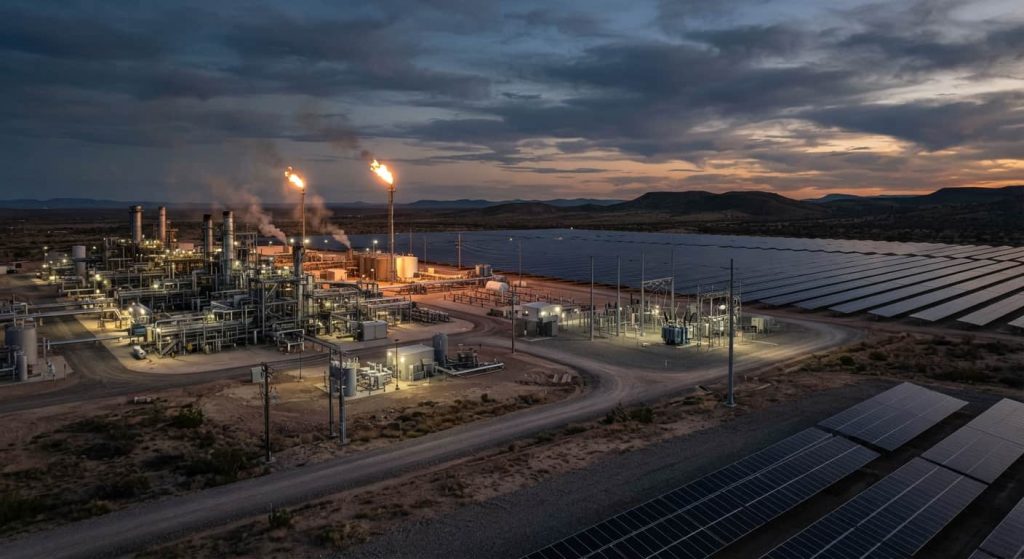
Flaring — burning off natural gas that's uneconomical to capture and transport, typically a byproduct of oil drilling — releases both CO₂ and unburned methane, a far more potent greenhouse gas. Companies like Crusoe Energy built a business model around installing mobile mining units directly at well sites to consume that otherwise-wasted gas instead. Crusoe has reported capturing nearly 22 billion cubic feet of gas that would have been flared across more than 425 modular units deployed in seven U.S. states, mitigating an estimated 2.7 million metric tons of greenhouse gas emissions — with the general reduction pegged at roughly 63% lower emissions compared to flaring the same gas outright, since combusting it for electricity is more complete than an open flare.
Worth flagging honestly: Crusoe itself has since shifted a significant portion of its business toward AI data centers under a "Bring Your Own Power" strategy, using the same on-site power generation approach originally built for flare-gas mining. That's not evidence the original Bitcoin mining use case was hollow — it ran commercially for years and the emissions-reduction figures are independently cited — but it's a reminder that this remains a niche within Bitcoin mining overall, not the industry's dominant energy source, and the company that pioneered it has largely moved its growth focus elsewhere.
What to weigh before accepting "Bitcoin mining is good for renewables"
The honest version of this story has real substance on both sides, and neither the "Bitcoin is an environmental disaster" framing nor the "Bitcoin mining saves the grid" framing survives contact with the full dataset intact:
- The sustainability improvement is real and independently verified — 37.6% to 52.4% sustainable in three years is a genuine trend, not industry spin, because it comes from Cambridge's methodology rather than self-reporting.
- Total energy consumption is still substantial and contested — somewhere between 138 and over 200 TWh annually depending on methodology, with real disagreement among credible researchers about which model is most accurate.
- Grid balancing and flare-gas capture are legitimate, documented use cases — but they're specific programs in specific regions (chiefly Texas), not a description of how the majority of global mining operates.
- Self-reported industry figures (BMC) run higher than independently audited ones (Cambridge) — a pattern worth remembering any time a mining company cites "our sector's sustainability rate" without naming whose methodology produced it.
Wes Ibarra has made the same point about Bitcoin mining coverage that applies to most of the claims in this space: the mechanics described are usually real, and the scale claimed around them is usually the part worth checking twice. Cambridge's 52.4% figure and ERCOT's curtailment data are solid ground. A press release's "our miners are carbon negative" is worth reading the methodology behind before repeating. More of his fact-checking on energy claims across the crypto sector is on his author page.
The fair summary
Bitcoin mining in 2026 draws on meaningfully more sustainable power than it did three years ago, participates in real and economically significant grid-balancing programs, and has demonstrable — if geographically concentrated — success turning wasted flared gas into usable electricity. None of that erases the fact that the network still consumes more electricity annually than most countries, and reasonable methodologies disagree by tens of terawatt-hours on exactly how much. Both of those things are true at once, and a genuinely informed take on Bitcoin's environmental footprint has to hold them together rather than picking whichever one fits the headline it's chasing.