
Every watt of electricity a Bitcoin mining rig consumes eventually leaves the machine as heat — that's simple thermodynamics, not a clever design choice. For years, that heat was treated purely as a cooling problem: something to vent, fan away, or dump into a river. A growing number of projects are testing a different framing — that low-grade waste heat, produced in enormous and predictable quantities, might actually be worth capturing rather than discarding. Greenhouses have become one of the more concrete testbeds for that idea.
The project that's putting this back in the news
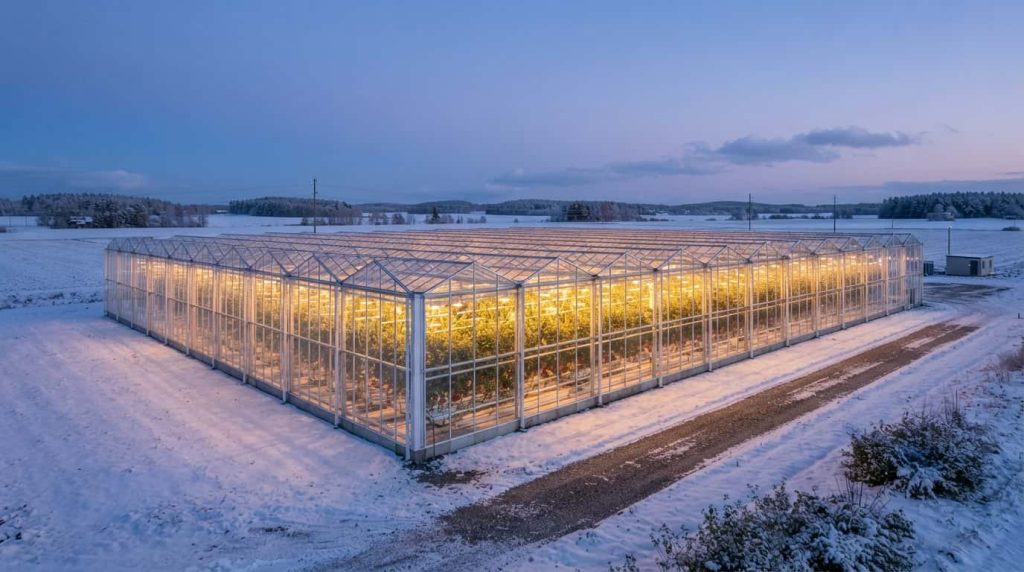
In January 2026, Canaan — a hardware manufacturer and one of the larger players in the Bitcoin mining equipment space — announced a 3-megawatt proof-of-concept in Manitoba, Canada, in partnership with Bitforest Investment. The pilot deploys 360 liquid-cooled Avalon mining units, with their coolant loop tied directly into the heating system of an operating commercial tomato greenhouse.
The mechanics are straightforward: instead of venting server heat into the air, a closed-loop heat exchanger uses it to preheat the water that feeds the greenhouse's electric boilers. Canaan's stated target is roughly 90% energy conversion to usable heat, with the liquid cooling system capable of outputting water above 75°C (167°F) — hot enough to meaningfully offset what the boilers would otherwise need to generate from scratch. The pilot is scheduled to run for 24 months specifically to measure heat recovery efficiency, system stability, and maintenance demands under real agricultural operating conditions — in other words, this is explicitly framed as a test, not yet a proven commercial model.
This isn't a first — it's part of a pattern
Manitoba tomatoes are the most recent headline, but heat-reuse-for-agriculture has been tested in several places over the past few years, with mixed but generally informative results:
| Project | Location | Approach |
|---|---|---|
| Canaan / Bitforest | Manitoba, Canada | 3 MW pilot heating a commercial tomato greenhouse |
| Genesis Mining | Northern Sweden | Research partnership directing airflow from mining containers into greenhouses growing fruit and vegetables |
| GreenMine | Netherlands | Liquid-immersion cooled mining container co-located with a tomato farm |
| MintGreen | British Columbia, Canada | District heating using mining waste heat, reporting roughly 3,100 tonnes of CO₂ reduction per megawatt annually |
| Genesis Digital Assets | Gothenburg, Sweden | 10 MW mining operation supplying about 20% of heat to a 2,700-home district heating network |
The Gothenburg project is worth noting specifically because it's operated as a public-private partnership between the municipality and the mining company — meaning a local government, not just a crypto firm's marketing department, has signed off on treating mining heat as legitimate infrastructure. That's a different kind of validation than a company's own press release.
How much heat are we actually talking about
K33 Research, a firm that tracks Bitcoin mining economics, has estimated that global mining produces roughly 100 terawatt-hours of waste heat annually — a genuinely large energy stream, on the same order of magnitude as the electricity consumption figures debated in coverage of the mining industry generally. The honest caveat is that only a small, though growing, fraction of that heat is currently being captured for anything. Most mining facilities worldwide still simply vent it, because heat recovery requires liquid cooling infrastructure, a nearby heat demand (a greenhouse, a district heating network, a pool), and enough proximity between the two to make piping the heat over economically sensible — three conditions that align far more easily in Nordic countries with existing district heating infrastructure than in, say, a converted warehouse in a hot climate.
Why this only works in some places, some of the time
The most credible coverage of this trend is careful about a limitation that promotional material tends to skip: heat demand is seasonal, and Bitcoin mining isn't. A greenhouse or a district heating network wants supplemental heat mainly during the colder months; a mining rig produces heat at a roughly constant rate year-round regardless of outdoor temperature. In summer, that excess heat has to go somewhere — commonly cited fallback options include pool or spa heating, preheating domestic hot water, or simply venting the surplus as before. Analysts modeling these systems put commercial greenhouses among the better-suited use cases specifically because plant heating demand, while still seasonal, tends to be more consistent and higher-value than residential heating alone, with reported payback periods in the range of five to eight years for large installations — and considerably shorter, closer to 18 months, for smaller-scale examples like immersion-cooled home rigs feeding a backyard swimming pool.
That last category — hobbyist-scale heat reuse — has actually produced some of the more well-documented small case studies: individual Bitcoin miners running immersion-cooled rigs to heat home swimming pools or caravans, reporting that the setup functions as an effective heat buffer with smaller temperature swings than conventional heating alone. It's a niche application, but it's a useful sanity check that the underlying physics works at small scale before extrapolating to commercial greenhouses.
What's genuinely proven versus what's still being tested
It's worth separating what these projects have actually demonstrated from what they're still trying to demonstrate:
- Proven: the basic engineering works — closed-loop heat exchangers can reliably capture high-temperature output from liquid-cooled ASICs and transfer it into a separate heating system, at both hobbyist and commercial scale.
- Proven, in specific deployments: district-scale integration can work with sufficient investment and the right infrastructure, as shown by Gothenburg's operational 10 MW system supplying a real residential district.
- Still being tested: whether heat recovery is economically viable as a standard feature of mining operations rather than a subsidized pilot, especially outside cold-climate regions with existing district heating networks. Canaan's own framing of the Manitoba project as a 24-month proof-of-concept, explicitly measuring "operational and maintenance intensity" as one of its key outputs, is a fairly clear signal that the economics aren't settled yet even by the company running the pilot.
Where this fits in the broader picture
Heat reuse doesn't reduce how much electricity Bitcoin mining consumes — it changes what happens to the heat that consumption already produces as an unavoidable byproduct. That's a meaningfully different claim than "Bitcoin mining is now more energy-efficient," and it's worth being precise about the distinction: a greenhouse warmed by mining waste heat still required the same electricity input to mine the Bitcoin in the first place. What changes is whether a second use — growing tomatoes, heating homes — gets extracted from that same energy for free, effectively getting two outputs from one input instead of one.
Wes Ibarra, who has covered a range of these "the mechanism is real, the scale is the open question" cases across the crypto-climate intersection, would likely frame this one the same way: heat reuse is a legitimate and physically sound idea with real operational deployments behind it, not vaporware — but it remains a genuinely small slice of the mining industry's total footprint, and treating a handful of pilot projects as evidence the sector has "solved" its waste-heat problem would be well ahead of what the data currently supports. More of his coverage on which Bitcoin sustainability claims are backed by operating projects versus press releases is on his author page.
What to watch next
The Manitoba pilot's 24-month timeline means real performance data — actual heat recovery rates, actual maintenance costs, actual comparison against the fossil-fuel boilers it's meant to supplement — should become available within the next couple of years, which will be a more useful benchmark than the announcement itself. Until then, greenhouse and district-heating projects are best read as promising, physically sound experiments with a handful of working examples behind them — not yet a demonstrated blueprint for what most Bitcoin mining operations will look like.